
5S is the Lean methodology built to fix exactly that. It creates a visual, orderly, clean, standardized, and sustainable work environment where every item has a place and every abnormality stands out immediately.
This article breaks down the five steps, how they connect to waste reduction and continuous improvement, and what a real-world rollout looks like from pilot area to full-facility standard.
Key Takeaways
- 5S stands for Sort, Set in Order (Straighten), Shine, Standardize, and Sustain
- 5S is a management system, not a one-time cleanup, built on standards, ownership, and leadership follow-through
- Well-run 5S programs drive measurable gains in productivity, safety, quality, and equipment reliability
- Start with a focused pilot area, measure your baseline, and scale only after refining the process
What Is 5S Lean Manufacturing?
5S organizes a workplace so that necessary items are easy to find, use, inspect, and put back. That's it in one sentence. The complexity comes from doing it consistently, across every shift, without letting it slide back into clutter after week three.
The methodology gets its name from five Japanese terms, each with a widely used English equivalent:
| Japanese Term | English Equivalent | What It Means |
|---|---|---|
| Seiri | Sort | Separate needed items from unneeded ones |
| Seiton | Set in Order / Straighten | Arrange what's left for easy access |
| Seiso | Shine | Clean while inspecting for problems |
| Seiketsu | Standardize | Lock in the gains with visual standards |
| Shitsuke | Sustain | Make it a daily habit, not an event |
Note that "Set in Order" and "Straighten" refer to the same step. Different consultants and companies favor different translations, and that's fine, as long as everyone on the floor is using the same term consistently.
How 5S Fits Into the Broader Lean System
5S traces back to the Toyota Production System, which centers on eliminating waste and pursuing daily incremental improvement, or kaizen. 5S doesn't replace kaizen or Total Productive Maintenance (TPM). It creates the stable, visible baseline those programs need to work.
The distinction that matters is simple: housekeeping cleans up a mess; 5S prevents the mess from forming. Each step ties directly to workflow design, visual management, abnormality detection, and accountability. A shadow board isn't decoration. It's a control that makes a missing wrench visible from across the room.
The Five Steps of 5S
Each step builds on the one before it. Skip Sort and you're organizing clutter. Skip Sustain and everything you built unravels within a quarter.
Sort (Seiri)
Sort separates essential items from the obsolete, excess, duplicated, or rarely used ones cluttering a work area. Ask of every item:
- What is its purpose?
- How often is it actually used?
- Who owns it?
- Where is its point of use?
Questionable items go through a red-tag process:
- Tag the item and record why it's under review
- Move it to a controlled holding area with a review deadline
- At the deadline, relocate, return, recycle, dispose of, or retain it
No item sits in limbo indefinitely.
Set in Order (Seiton)
Once only necessary items remain, arrange them by workflow, frequency of use, ergonomics, and point of use. Practical tools here include:
- Shadow boards with tool outlines
- Labeled storage bins and shelving
- Floor markings for walkways and equipment zones
- Color coding by function or department
- Defined locations for work-in-progress
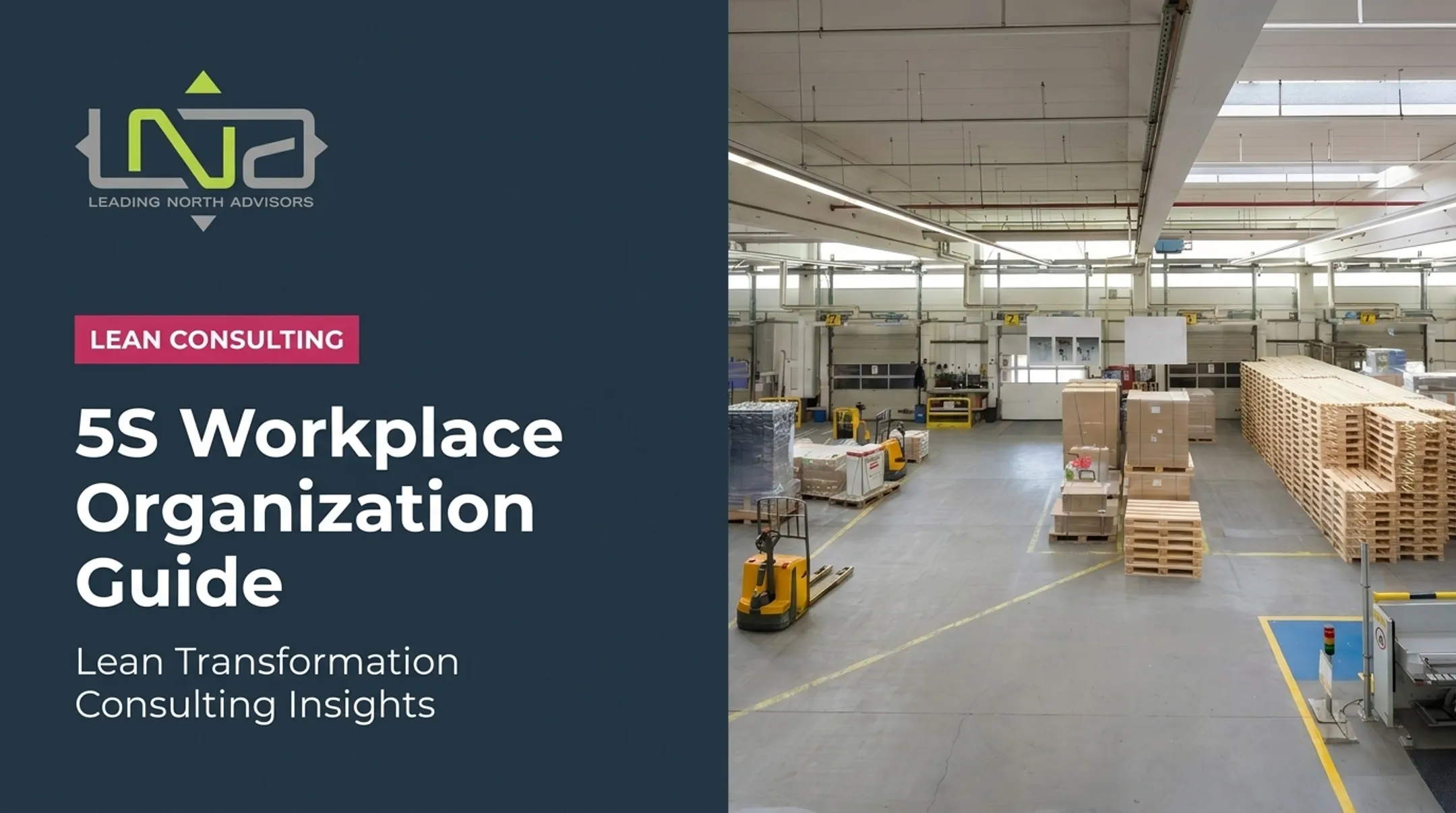
In implementations Leading North Advisors supports, a common visual marker is clearly marked yellow floor lanes that separate pedestrian paths from material flow. It's a small detail, but it prevents forklift-and-foot-traffic incidents.
Shine (Seiso)
Shine combines cleaning with inspection. Operators clean equipment and work areas while actively looking for leaks, wear, loose components, contamination, and other abnormal conditions.
This step connects directly to preventive maintenance. A machine cleaned daily by the person running it reveals early warning signs—an oil stain or a hairline crack—long before they become downtime events.
Shine also builds operator ownership. The person who cleans the equipment tends to notice, and report, when something's off.
Standardize (Seiketsu)
Standardize documents the best practices created during Sort, Set in Order, and Shine. Without this step, improvements erode within weeks because nobody wrote down what "good" looks like.
Common tools include:
- Concise cleaning and inspection checklists
- Before-and-after photos posted at the workstation
- Job cycle charts and standard work instructions
- Visual controls with clear pass/fail criteria
It also covers role assignments, shift handoffs, and version control so a day-shift standard holds up on night shift, with room for practical local adaptation.
Sustain (Shitsuke)
Sustain turns the first four steps into daily habits. This is where most 5S programs fail, not because the launch was bad, but because nobody kept it alive.
Sustain requires:
- Including 5S expectations in new-hire onboarding
- Scheduled 5S activities and leadership walk-throughs
- Recurring audits with clear scoring criteria
- Using audit findings and operator feedback to update standards, not just check compliance
Treat compliance as a checkpoint, not the finish line. If an audit keeps flagging the same issue, the standard itself probably needs revising.

Optional Sixth S: Safety
Safety isn't one of the original five Japanese terms, but some organizations add it as a sixth S because organized, clean, well-marked work areas make hazards easier to spot.
Formal safety work still needs its own system. Machine guarding, hazardous-material controls, ergonomic assessments, and regulatory compliance are not automatically covered by 5S—even when good 5S execution improves safety outcomes.
Benefits of 5S in Manufacturing
5S attacks several Lean wastes directly: unnecessary motion, waiting, excess transport, overprocessing, and underused space. When items have a fixed, labeled home, search time drops and material-handling steps shrink.
The results aren't hypothetical. A 2009 ASQ case study of a U.S. Naval Ship Repair Facility documented an 80% reduction in time spent searching for parts after a lean 5S materials-inventory intervention.
A separate 2022 peer-reviewed case study of a plastic bag manufacturer found operational time fell 8% in blowing and 18% in printing, with overall production efficiency rising from 67% to 88.8%. These are specific, named results, not universal guarantees, but they show what's achievable with focused execution.
Beyond search time, expect these connected outcomes:
- Quality and reliability: Cleaning-as-inspection catches leaks and wear before they cause defects or downtime
- Safety and ergonomics: Clearer walkways and fewer trip hazards reduce incident risk
- Employee engagement: Teams report more pride and ownership in an organized space
- Space utilization: Removing excess inventory frees floor space for actual production
Internal reporting at Leading North Advisors shows clients commonly see measurable gains—better organization, higher productivity, and shorter search times—within 30 to 60 days of launch.
One caution: don't build an audit that rewards appearance while ignoring outcomes. A pristine floor with rising defect rates isn't a 5S success. Track adherence alongside quality, delivery, cost, safety, and employee feedback so the scorecard reflects the whole picture.

How to Implement 5S Successfully
Start With Leadership Alignment
Tie 5S to a specific business problem, not a vague desire to "get organized." Long parts searches, recurring defects, excess inventory, and safety near-misses are all legitimate starting points. Before the first 5S event, name the sponsor, facilitator, and area owner, and pull in operators, maintenance, quality, and safety reps.
Select and Baseline a Pilot Area
Pick one work cell, line, or storeroom with visible problems and a willing team, not the entire facility at once. Document the starting condition:
- Take before photos
- Run a simple 5S assessment
- Record baseline measures: search time, defects, downtime, or space usage
Run the Five Steps With Employee Involvement
Operators should help decide what's necessary, where items belong, and what obstacles get in the way. Useful aids include:
- Red-tag registers
- Labeled locations and floor markings
- Short daily 5S routines
Leading North Advisors' True North Delivery® approach pairs training with hands-on practice so teams build the habit of sustaining changes themselves, instead of depending on a consultant to keep the area clean.
Standardize, Train, and Audit
Create simple, visual standards and train every shift, including new-hire onboarding. Schedule recurring audits or layered process reviews. Every finding needs an owner and a due date. Audits disconnected from follow-up just breed resentment.
Scale and Sustain Across Teams or Sites
Refine the pilot, share what worked, and roll out progressively while keeping common definitions, color conventions, and reporting consistent across sites. If rollout design, internal facilitator training, or multi-site coaching is the bottleneck, a Lean transformation and certification partner such as Leading North Advisors can help keep momentum after the pilot months.

Frequently Asked Questions
How do you implement 5S in a manufacturing industry?
Align leadership on a specific business problem, then pick a pilot area and baseline it. Run Sort through Sustain with employee involvement, visual standards, shift training, and regular audits tied to operational outcomes.
What are the five steps of the 5S methodology?
The five steps, in order, are Sort, Set in Order (or Straighten), Shine, Standardize, and Sustain. Each step builds on the previous one, so skipping ahead undermines the results.
What are the 5S's in Lean manufacturing?
They're Seiri (Sort), Seiton (Set in Order), Seiso (Shine), Seiketsu (Standardize), and Shitsuke (Sustain). Together they create the stable, visual foundation that Lean improvement work depends on.
What is 5S in kaizen?
5S is a foundational workplace-organization practice, not kaizen itself. It supports kaizen by making waste, clutter, and abnormalities visible enough for teams to actually notice and improve them.
What are five commonly used Lean manufacturing tools?
There's no single official list, but 5S, Kaizen, Kanban, Just-in-Time, and Total Productive Maintenance are frequently cited examples. Organizations typically select tools based on the specific operational problem they're solving.